Posts

Showing posts with the label art therapy

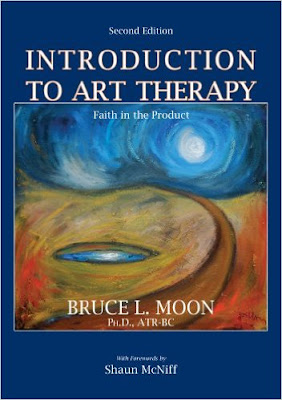
#CBR8 Review #03: Introduction to Art Therapy - Faith in the Product by Bruce Moon
Image
I feel like at the stage that I am at in my art therapy program, it is strange to have to read a book with the words "Introduction to Art Therapy" in the title. Shouldn't I be past that? And I have indeed already been required to read a lot of other material by Bruce Moon in the same field. And yet, something about this book really helped at this point in my studies with concretizing some ideas for me that I have been presented with before, but have not yet really envisioned the practicalities or application of. If that makes sense? It also helps that Moon has a very straightforward writing style that captures the essence of what he is trying to say, without being too dry like many textbooks, or too abstract like I have actually found a number of the texts in art therapy in particular to be. In this book, Moon essentially lays out some information on the development of art therapy in the US, briefly describes some of the major theorietical foundations within the field...

#CBR7 Review #08: The Art of Grief by J. Earl Rogers

Image
I come to read a book on with grief through creative arts therapies at a time wherein I face the impending death of a family member. And I am restless. Being a fidgety person to begin with, I can’t keep my hands still when my mind is full of all kinds of thoughts: preparing for courses in school, learning about grief for an upcoming class, dealing with loss and grief myself, and all other kinds of things. And so I draw. My hands take what I am feeling and put a part of me on a page. And I am not entirely okay, but I also don’t feel like I’m drowning like I have felt all too much recently for far too many reasons. But enough about me… The Art of Grief: The Use of Expressive Arts in a Grief Support Group is predominantly set up as a guide to running bereavement support groups that utilize the expressive arts as a process of healing and working through grief. Different practitioners with a variety of creative and therapeutic backgrounds contribute ideas and sessions that are set u...

#CBR7 Review #04: The Silver Drawing Test and Draw a Story by Rawley Silver

Image
When I tell people that I am studying art therapy they often say things like: “so if I showed you one of my drawings you’d be able to tell me what’s wrong with me?” Um… no. That’s not how it works. Everyone approaches artwork from their own experiences with their own perspectives, and therefore often interpret pieces very differently from one another. Sometimes they aren’t even close to what the artist themselves intended. But whatever comes from the artist through their creative expression is an extension of the self, and can possibly provide some clues, cues, or ideas that may be further explored, but as guided by the client’s needs (and not hasty therapist interpretations which may end up being misleading). Yet there are some simple drawing tasks that have been developed that can act as basic assessment tests. Presented in this book are the Silver Drawing Test, which assesses cognitive and emotional development, and the Draw a Story assessment which may be used to predict dep...

#CBR7 Review #03: Art Therapy and Postmodernism by Helene Burt

Image
In preparation for an upcoming course on issues of professional practice in art therapy, I read this book on postmodernism and art therapy, as edited by Helene Burt. The book itself is comprised of a number of different author’s contributions, who are practicing or researching art therapists themselves. The focus of the chapters vary, based on the practitioner’s area of personal research or practice. They include areas such as: language differences between clients and therapists, working with a diversity of culture in certain areas, feminist theory and art therapy, and working with transient youth populations. The one string that ties everything together, however, is the fact that the ideas presented all fall into what would be considered postmodernism ideas. The one problem I found, however, was that how each author understands postmodernism is not specifically defined by them. In a book that emphasizes individual differences and the individual experience, it would make sense f...

#CBR6 Review #30: Approaches to Art Therapy, Theory & Technique, Edited by Judith Rubin

One last textbook review for the year! At least that’s what I’m telling myself. In Judith Rubin’s second edition of Approaches to Art Therapy , she invites various authors and therapists to contribute chapters on their different theoretical approaches towards art therapy. These are divided into various subsets, including the psychodynamic approaches, humanistic, psycho-educational, integrative, and systemic or group therapy approaches. As with any book written with various authors making contributions, some chapters read easier and are more inviting than others. Similarly, some of the theoretical frameworks are much easier to understand and I seem better able to connect with than others. Yet, seeing a vast range of approaches to one field is always important, as all the different frameworks contribute something different that may be more useful to some patients than others, and can be integrated into a therapist’s main theoretical approach that they develop personally over time. ...

#CBR6 #23-25: Systems Therapy, Genograms, and Helping Skills

More textbooks! I swear this isn’t all I read, but when you have to read so much for school, the last thing you want to do when you have free time is crack open another book (so shameful, really, but I just got a few new comic books I should be able to work my way through soon!). And so, here are a few more of my required readings for my current educational program in art therapy. This joint review is for the following: - Essential Skills in Family Therapy: From the First Interview to Termination (2 nd edition) by Patterson, Williams, Edwards, and Chamow - Genograms: Assessment and Intervention (3 rd edition) by McGoldrick, Gerson, and Petry - Helping Skills: Facilitating Exploration, Insight, and Action (4 th edition) by Clara E. Hill First things first, “Essential Skills in Family Therapy” focuses on the basics of working with families and other systems in therapy. What I liked most about it was the fact that they did not assume the reader would be well-versed in ...

#CBR6 Reviews #17-18: More on Art Therapy...

Image
I promise that I will read and review something different soon, I’ve just been very focused on my school readings right now. And so, here is some more on art therapy! And two very different approaches and focuses within the field at that: - Studio Art Therapy: Cultivating the Artist Identity in the Art Therapist by Catherine Moon - Introduction to Art Therapy: Sources & Resources by Judith A. Rubin Judith Rubin’s Introduction to Art Therapy is just that: an overview of the different possibilities inherent in the field of art therapy, taking a look at the various pioneers of the field who contributed to its history and progression to today, as well as many of the different theories and practical models that may inform one’s practice. The book is a conglomerate of a broad scope of information, yet doesn’t go too in-depth in any particular area. Interspersed throughout, Rubin provides personal cases that she has faced with a number of clients over the years, showing ho...

#CBR6 Review #16: Spirituality and Art Therapy: Living the Connection by Mimi Farrelly-Hansen

Image
An edited collection of essays from a number of different practicing art therapists, from a diversity of backgrounds. Each author presents a different view of art therapy practices, and stems from a different spiritual background, yet they all focus on the connection between creative expression, artistic practices, and the spiritual sense of the human soul. Ranging anywhere from Christianity to Buddhism to Spiritualities connected to the Natural world, the authors tell their personal stories, as well as those of clients that they have worked with, all using the arts to connect them with something greater outside of the self. In turn, discovery of the self and the spirit comes from relating and engaging in the artistic and spiritual world. Now, this all may sound a little hokey to some, and I understand that: art therapy isn't for everyone. But for those that can really engage and connect to the process, it can be vital in providing a sense of healing, or at the very least, a re...

#CBR6 Review #03: Art is a Way of Knowing by Pat Allen

Image
I read this book as a part of my readings for a class in art therapy fundamentals. Personally, I think that this book is more suited to those who have an interest in art therapy, or particularly like the tales of people’s personal journeys. Because that is what this book is: the recounting of Pat Allen’s personal journey once she understands what art can do for her in an emotional and spiritual way. It also lays out some exercises and suggestions as to how the everyday person might come to explore their own soul and life through creating art. But would these tactics work for everyone as profoundly as they did for Allen? Maybe for some, but definitely not for others. That is the nature of art therapy, though, isn’t it? Art is a Way of Knowing begins with Allen laying out how one can come to explore using art themselves, and as she does so, begins recounting some of the early events in her life. Things come into much more detail once she reaches discussing her time studying art, ...